Ten orcas crashed Monterey Bay’s humpback party this week
Two known pods spent the week breaching, sharing prey, and hunting alongside the biggest humpback numbers of the summer. Here’s what’s going on out there.
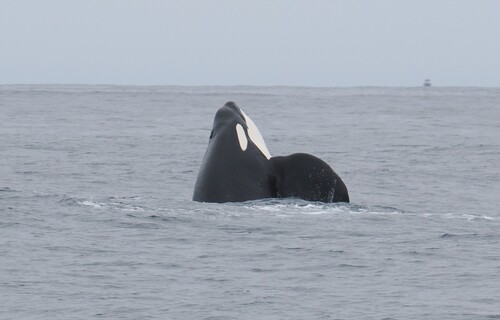
On Friday morning, the 10 a.m. whale watch out of Monterey found itself sharing the water with ten killer whales. It was not a drive-by. Earlier in the week, on Monday the 29th, seven orcas from two identified pods put on the kind of show naturalists talk about for years: breaching, passing close alongside the boat, sharing prey, and, according to the trip log, harassing seabirds for what looked like sport.
The pods have names: the CA51As and CA50B. Researchers up and down the West Coast know these animals individually, by the nicks in their dorsal fins and the shape of the gray saddle patch behind them. The CA51As are a family group, a matriarch and her descendants, that has been working the California coast for decades.
These are Bigg’s killer whales, the mammal-hunting kind. Unlike the salmon-eating resident orcas of the Pacific Northwest, Bigg’s orcas eat sea lions, harbor seals, and, in spring, the occasional gray whale calf. The two groups look nearly identical, but they are separate cultures in the fullest sense: different diets, different dialects, and they have not interbred in tens of thousands of years.
Monterey Bay is one of the most reliable places in the world to cross paths with them, and the reason is the canyon. The Monterey submarine canyon, as deep as the Grand Canyon, brings open-ocean water within a mile of the beach, and the coastline around it is stacked with the sea lions and seals a mammal-hunter wants. Spring is the classic season, when pods ambush gray whale calves on the northbound migration. But the food never really leaves, and neither, entirely, do the orcas.
The numbers say this week was special even by Monterey standards: 13 orca reports in the past month, more than double the month before, with most of them landing in the last few days. For an animal that can cover a hundred miles in a day and answers to no schedule, that is a hot streak. Track the live picture here.
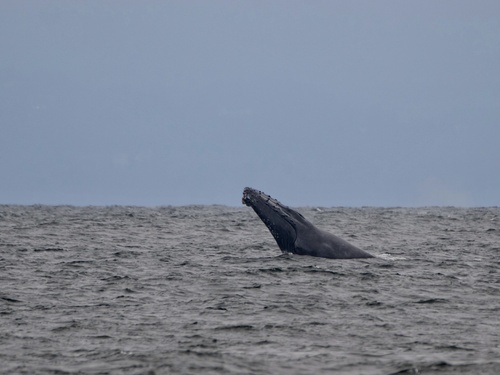
The orcas are sharing the bay with the thickest humpback numbers of the summer. Humpback whales have been logged 146 times in the past four weeks, more than triple the month before, and on Wednesday a single morning trip counted 35 of them. What those boats are watching is lunge-feeding: a 40-ton whale accelerating open-mouthed through a school of anchovies, seabirds wheeling overhead to pick up the leftovers. This is the canyon’s summer engine running exactly as designed. Wind-driven upwelling pulls cold, nutrient-rich water to the surface, the anchovies and krill pile up along the canyon edge, and the whales pile in after them, June through October.
And north of the Golden Gate, a different spectacle is building: brown pelican squadrons are streaming up the Sonoma coast, 52 reports at Bodega Head in the last two weeks, six times last month’s pace, as post-breeding birds disperse north from the Channel Islands and glide inches above the swells.
Also on the move: sea otter pups at Elkhorn Slough, the heron rookery in Golden Gate Park, and harbor seals hauled out at Point Lobos.